Sunday, September 21, 2008

Sunday, August 31, 2008
Saturday, August 02, 2008
Monday, June 30, 2008
Sunday, June 01, 2008
Il Bel Paese
Five days is a very short time to cover all that "territory" and see part of Il Bel Paese (the beautiful country – how Italians colloquially refer to their country)! Are the visitors traveling by Europass (train)? If so, they may want to "experience" Il Pendolino (ETR 460) – the high-speed train between Florence and Rome. It's called Il Pendolino because of its "pendulum" rocking or tilting motion at top speed (about 220 km/hr = 160 mph). It will get you to Rome in a little over an hour (as opposed to almost 4 hours on the regular train). They can get to Florence from Pisa very quickly by regular commuter train service. I only visited Pisa a few times, but not to miss, of course, is the Torre Pendente (Leaning Tower – http://torre.duomo.pisa.it/index_eng.html), actually the bell tower of the cathedral. While "shoring up" still continues, visits to the tower are once again allowed - if you dare - with a maximum of 30 persons at a time! Of course, don't forget the magnificent Duomo (the cathedral) and the Piazza dei Miracoli (the square between the Tower and the Duomo), where you can take your famous photo, holding out your arms to "steady" the Tower, if you frame the shot in your camera just right! Of course, if they have time in Florence they should at least "pay a visit" to Michelangelo's Il David at the Galleria dell'Accademia (in English at http://www.polomuseale.firenze.it/accademia/). The lines to get into the various museums in Florence can remind you of those at Disneyworld, so plan accordingly! Of course, you can also see David if you attend my first lecture in 4th semester! I could write a book (actually several!) on Roma (Roma is Amor (Love) spelled backwards!). Since Rome has a very good public transportation system, for getting around Rome it pays to buy a Roma Pass (an open 3-day ticket for unlimited rides on all buses and the Metro [the subway] available at all tabacchai [cigarette shops; square black sign with a white "T"] and ATAC [the municipal transport company] kiosks throughout the city). With just a day or so, I would try to at least take in the Vatican Museums (Metro stop Cipro-Musei Vaticani on the linea A (A line). Subway stations are marked above ground with a square red sign with a white "M". The Metro has a great site (in English, with interactive maps – Java required) at http://www.metroroma.it/MetroRoma/HTML/EN. At the Vatican Museums, get on line early – around 7 AM – so as to be the first ones in). Also not to miss – St. Peter's Basilica (the elevator ride to the roof and climb by foot up the circular staircase from there to the top of the cupola are well worth the magnificent photos of Rome you can get) and Piazza San Pietro (St. Peter's Square), and the Foro Romano (Roman Forum), Colosseo (Coliseum), Piazza Venezia, and Piazza di Spagna (the Spanish Steps). These can all be reached easily – and quickly – by subway or bus. There is also a wonderful – and cheap (cost = 16 € [symbol for euros] = about US$20) – overview bus tour of the entire city conducted by ATAC (the Rome municipal bus company). It takes about 3 hours, with 20 minute stops at each major site. There are departures every 15 minutes from Piazza del Cinquecento (square in front of Termini [Rome's prinicipal train station]) on the red open-decker #110 bus (linea 110 open ["hop on-hop off"] bus) - with multilingual hostesses. "Back in my day" it was conducted by a real Roman bus driver pointing out the sites in Romanesco dialect and some English. It didn't really matter if you understood what he said – it was just fun to hear his beloved city described in the very colorful "language" of that city (it was like having Ralph Kramden of "The Honeymooners" drive you around NYC in his bus!). Complete information on this – as well as all other activities in Rome, including detailed maps – is available on a fantastic interactive site (in English) at http://www.romaturismo.it/v2/en/main.asp (you'll need FlashPlayer 6). This site is well worth a "visit". If you're a fan of Dan Brown's The DaVinci Code, you may be interested in the "Angels and Demons Tour of Rome". Angels and Demons was his "prequel" to The DaVinci Code in which the mystery plot is entirely set in Rome, with famous historical sites in Rome offering "clues" to unraveling the mystery! More information on this very unusual "activity" (and a rather extraordinary way to "see" Rome) may be found at http://www.angelsanddemons.it/tour.asp. Speaking of The DaVinci Code, don't miss Leonardo DaVinci's Cenacolo (The Last Supper) at the Church and Convent of Santa Maria delle Grazie in Milan. A useful website (in English) is http://www.cenacolovinciano.it/html/eng/home.htm. While for me (an opera fan), Milan means Teatro Alla Scala (the opera house) [ http://www.teatroallascala.org/public/LaScala/EN/index.html], if you're not an "opera buff" DaVinci's masterpiece is about the only worthwhile thing to see in Milan – apart the Gothic cathedral with its gargoyles (like Notre Dame in Paris!). Milan will "feel" somewhat like NYC with its "grid-pattern" streets (vie) and broad avenues (viali) at right angles to each other, as well as its extensive bus and subway system.
Unfortunately, I can offer you no "enlightenment" about Monaco or Nice (Nizza in Italian - it used to be part of Italy [the powerful seafaring Republic of Genoa] until it was ceded to France as an award for French assistance in Italy's Second War for Independence against Austria in 1860). I've never been to either.
I leave you with an interesting "tidbit" about a famous Roman site with a "medical connection". As you walk out of St. Peter's Square, with the Basilica to your back, and head down the broad, straight Via della Conciliazione which will lead you to the Ponte Sant'Angelo (Holy Angel Bridge) across the Tevere (the Tiber River), the Castel Sant'Angelo (Holy Angel Castle) will pop into view at the end of the via. This "castle" was originally the Emperor Hadrian's mausoleum, but was converted into a papal fortress in the Middle Ages (and is connected to the papal apartments in the Vatican by a "secret" covered corridor [il Corridoio Vaticano]). While perhaps best known – at least by me (an "opera buff") – for the climax of the 3rd Act of Giacomo Puccini's opera Tosca, when the heroine jumps to her death from its roof in desperation after the execution of her lover at the hands of the papal troops (during Napoleon's siege of Rome), it also "hides" a little-known bit of art (and, in a sense, medical) history. There is a statue of the Archangel Michael (the Sant'Angelo [Holy Angel] in the castle's – and adjacent bridge's – name) at the very top. The archangel, very oddly, is not drawing – but sheathing – his sword. Why???
It is in commemoration of Pope Saint Gregory the Great having been said to have seen the Archangel sheath his sword in sign of the passing of the great bubonic plaque of the year 590!
Buon Viaggio (Have a good trip) and Salutami a Roma (Give my regards to Rome)!!!
Unfortunately, I can offer you no "enlightenment" about Monaco or Nice (Nizza in Italian - it used to be part of Italy [the powerful seafaring Republic of Genoa] until it was ceded to France as an award for French assistance in Italy's Second War for Independence against Austria in 1860). I've never been to either.
I leave you with an interesting "tidbit" about a famous Roman site with a "medical connection". As you walk out of St. Peter's Square, with the Basilica to your back, and head down the broad, straight Via della Conciliazione which will lead you to the Ponte Sant'Angelo (Holy Angel Bridge) across the Tevere (the Tiber River), the Castel Sant'Angelo (Holy Angel Castle) will pop into view at the end of the via. This "castle" was originally the Emperor Hadrian's mausoleum, but was converted into a papal fortress in the Middle Ages (and is connected to the papal apartments in the Vatican by a "secret" covered corridor [il Corridoio Vaticano]). While perhaps best known – at least by me (an "opera buff") – for the climax of the 3rd Act of Giacomo Puccini's opera Tosca, when the heroine jumps to her death from its roof in desperation after the execution of her lover at the hands of the papal troops (during Napoleon's siege of Rome), it also "hides" a little-known bit of art (and, in a sense, medical) history. There is a statue of the Archangel Michael (the Sant'Angelo [Holy Angel] in the castle's – and adjacent bridge's – name) at the very top. The archangel, very oddly, is not drawing – but sheathing – his sword. Why???
It is in commemoration of Pope Saint Gregory the Great having been said to have seen the Archangel sheath his sword in sign of the passing of the great bubonic plaque of the year 590!
Buon Viaggio (Have a good trip) and Salutami a Roma (Give my regards to Rome)!!!
Wednesday, February 20, 2008


Wednesday, May 02, 2007
Friday, January 26, 2007
Pessimism vs. Existentialism
JANUARY 26, 2007
Pessimism is back. That will not surprise anyone who has been keeping track of the nation's pulse over the past several months — or perhaps the last several years. Jimmy Carter's "malaise" speech, which may have cost him a second term, would not be at all inappropriate today. Our famous American optimism faces a mortal threat in the combination of an unwinnable war, a collapsing dollar, a sagging economy for most people, trouble on the job front for graduating students, and lowered expectations generally. And that's aside from the recent scandals among our religious, corporate, and political leaders, and the pervasive suspicion that results.
So opined Adam Cohen recently in the International Herald Tribune, and so, too, according to a recent book by Joshua Foa Dienstag, a political scientist at the University of California at Los Angeles, Pessimism: Philosophy, Ethic, Spirit (Princeton University Press, 2006). In his defense of pessimism as an appropriate and realistic philosophy, Dienstag points to the usual suspects: Arthur Schopenhauer, of course, the great 19th-century pessimist; but also Friedrich Nietzsche, and Albert Camus and the modern movement called existentialism.
I do not disagree with the diagnosis, but I am disturbed by the continued reference to existentialism as a pessimistic, negative philosophy. It is often considered such. Only a few weeks ago I heard a radio commentator declare that the "nothing really matters" lyric from Queen's "Bohemian Rhapsody" was truly "existential." And I still hear pundits and some of my university colleagues decry existentialism as the source of our nihilistic gloom, the reason why our students don't vote and why they experiment with dangerous drugs. I listen to such comments with a mix of amusement and horror because I like existentialism and I think that existentialism, not pessimism, is what America needs right now.
Existentialism is said to be all about "the death of God," the meaninglessness of human life, and the anxiety those provoke. It is in the face of such anxiety that one needs the courage to make meanings, to be oneself. The theme gets dutifully traced back to Søren Kierkegaard and Nietzsche, and forward through Martin Heidegger, Camus, Jean-Paul Sartre, Paul Tillich, and Viktor Frankl, always with a touch of heroism but surrounded by the darkness of despair and ultimate meaninglessness.
In the early years of existentialism in postwar Europe, the emphasis was indeed on gloom and hopelessness. The books and articles that made the biggest splash — William Barrett's Irrational Man, for instance — were those that bemoaned the death of God and the despair and meaninglessness that are implied by that cosmic absence. That was challenged in the 60s by the celebrations of hipness in the United States at the hands of Norman Mailer, in Advertisements for Myself, and some of the Beats. The heady optimism that ruled America in those years leavened the Old World gloom and turned meaninglessness into a challenge, recasting the death of God into a sense of liberation. Even in Europe, existentialism came to present itself as a positive philosophy, a philosophy of hope, in works like Camus's essay "The Rebel" and Sartre's lecture "Existentialism Is a Humanism."
It is my contention that the whole movement has been misinterpreted, turned upside down by three generations of critics and commentators. Needless to say, the perception of existentialism as an atheistic philosophy has had a lot to do with that, since there have been a lot of people with a vested interest in the idea that a world without God could not possibly have meaning. But apart from that dubious contention, such interpretations display real ignorance of the fact that one of the leading existentialists, Kierkegaard, was a devout Christian, and many existentialists since — Karl Barth and Martin Buber, to pick just two — weren't atheists at all.
Why does existentialism have so much trouble shaking its nihilistic and gloomy image? To be sure, its leading promoters are rarely pictured with happy faces, but then how many philosophers in history have ever been depicted as smiling?
Yet few philosophers have displayed such unmitigated joy in their writing as Kierkegaard and Nietzsche. The latter wrote: "At long last our ships may venture out again, venture out to face any danger; all the daring of the lover of knowledge is permitted again; the sea, our sea, lies open again. Perhaps there has never been such an 'open sea.'"
Even Sartre, not only in his plays and novels but even in his heaviest philosophy, seems to be thoroughly enjoying himself. But when it comes to understanding the content of what they are doing, interpretations of Kierkegaard and Nietzsche seem utterly wedded to the thinkers' supposedly intimate concern with despair and nihilism. A perennial question (students love it for both term papers and doctoral theses) is whether Nietzsche was a nihilist or not.
The answer is a straightforward no. Nietzsche warned Europe of the encroachment of nihilism, which he associated with the Christian denial of life. Nevertheless, the association of Nietzsche and nihilism lingers, despite the fact that his whole philosophical effort is to provide an alternative to nihilistic thinking.
Kierkegaard — dutifully cited as author of The Concept of Dread — is often considered the modern inventor of the Absurd — a century before Camus. However, the ultimate indeterminacy of human existence and the need to make genuine choices (including the decision to believe in God, Kierkegaard's famous "leap of faith") lay at the heart of his whole philosophy, and those concepts were anything but negative. "Christianity is certainly not melancholy; it is, on the contrary, glad tidings — for the melancholy," he wrote. Furthermore, Kierkegaard never lets us forget that it is only through such acts of choice that we make ourselves into authentic "existing individuals." He even talks of "bliss."
So, too, in celebrating "the open sea" of possibilities that greets us after the death of God, Nietzsche aspires to a mood of unmitigated cheerfulness. Even Heidegger and Sartre, the grand old Mr. Cranky and Mr. Grumpy of German and French existentialism, respectively, aim not at despair but at a kind of rejuvenation. Sartre, in particular, claims, in response to a question about despair, that he has never experienced it in his whole life. (That may throw into question his credibility, but it's nonetheless instructive as to his broad philosophical outlook.)
Perhaps the wartime experiences of Mr. Cranky put him beyond the reach of any celebration of life, but Mr. Grumpy insists that existentialism provides an experience of incredible freedom, a feeling of responsibility that is not so much a "burden" as a matter of finding one's true self-identity. If nihilism and despair play any role in this picture, it is only as background against which existentialism is the ecstatic resistance. Responsibility and choice, picking oneself up by the bootstraps, are what this positive version of existentialism is all about.
We hear so much about "the burden of responsibility" that we forget the basic lesson of existentialism: that responsibilities enhance rather than encumber our existence. Call me naïve, but most people take on responsibilities because responsibility puts them in charge of their lives and defines just who they are. Most people who enter public service, for example, do not do so because of a selfish lust for power and wealth. They usually want to change things for the better, make a contribution, and even the most corrupt and vile politicians will confess a lingering hope that that is how they might be remembered. As Sartre constantly reminds us, we are what we do.
In short, existentialism is not a philosophy that allows us to feel sorry for ourselves in the midst of our malaise. It is a philosophy with which we can come to grips with these terrible times and actually change them. The recent midterm election was encouraging. What it suggests is that America is collectively recouping its existentialist roots, not because of national pessimism but because of what I hope is the beginning of a cooperative optimism and the sense that things as they are cannot stand.
Why does existentialism matter? Who cares about the viability of a European philosophy that may have once been the fetish of sophisticated poseurs and profligates but has little relevance to anything today? My answer is that philosophy is always relevant, that, as the proto-existentialist Johann Fichte once said: "What system of philosophy you hold depends wholly upon what manner of man you are." And if I am right that existentialism defines an important stream of American life and thought, especially its individualism and insistence on self-reliance, that means that we should become both aware of and critical regarding what that philosophy is and what it portends.
Robert C. Solomon was a professor of philosophy at the University of Texas at Austin. He died on January 2 while traveling in Europe.
http://www.chronicle.com/article/Pessimism-vs-Existentialism/8935
Section: The Chronicle Review Volume 53, Issue 21, Page B5
Sunday, August 13, 2006
Wang suffers home loss to Angels
 Yankees outfielder Hideki Matsui fielded fly balls and grounders during Yankees batting practice.
 Pitcher Mike Mussina discussed a pitching grip with fellow pitcher Jared Wright.
 Fans arrived ready to show their support for Chien-Ming Wang.
Friday, July 28, 2006
Wang records first shut out in victory against Tampa Bay
 Bernie Williams rounds the bases after hitting a solo home run in the sixth inning.
 Wang completes the shutout, throwing a two-hitter. He walked two, struck out one, and allowed only one Tampa Bay player to reach third base.
Thursday, July 27, 2006
Chien-Ming Wang Day; Wang's #41 retired by Staten Island Yankees
 Chien-Ming Wang Day at Richmond County Bank Park, home of the Staten Island Yankees.
 Taiwanese media interview a young fan.
 Taiwanese media turn their attention to Wang as he appears in the dugout prior to the pre-game uniform number retirement ceremony.
Monday, July 17, 2006
Wang defeats Mariners for 10th win
 Some Taiwanese fans await Chien-Ming Wang's arrival for pre-game warmups in the bullpen.
 Mariners rightfielder Ichiro Suzuki stands on first after hitting a single on the first pitch of the game from Wang.
 Apparently, when not rehabbing for the Colorado Rockies, Chin-Hui Tsao (#71) watches one of Wang's games.
 Mariano Rivera picks up career save number 401 to help Wang improve his record to 10 W, 4 L.
Friday, June 23, 2006
Wang inconsistent against Florida but earns eighth win
Wang had one bad inning, but completed seven innings to earn the victory.
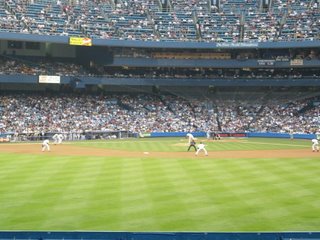 Wang gets Florida's Mike Jacobs to ground into a double play to end the top of the 1st inning.
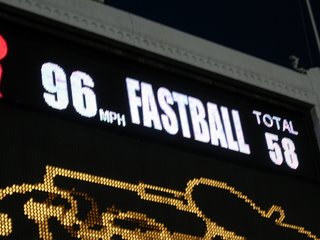 After giving up a two-run home run to Florida catcher Miguel Olivo in the 2nd inning, Wang opened the top of the 5th inning by striking out Olivo looking at a 96 MPH fastball.
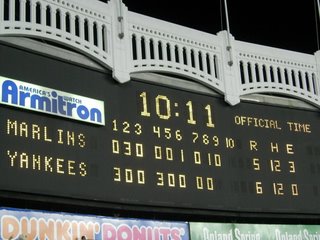 Kyle Farnsworth gave up a run in the 8th, but Mariano Rivera saved another win for Wang.
 Wang gets Florida's Mike Jacobs to ground into a double play to end the top of the 1st inning.
 After giving up a two-run home run to Florida catcher Miguel Olivo in the 2nd inning, Wang opened the top of the 5th inning by striking out Olivo looking at a 96 MPH fastball.
 Kyle Farnsworth gave up a run in the 8th, but Mariano Rivera saved another win for Wang.
Tuesday, June 13, 2006
Wang wins another pitching duel, defeating the Indians for his seventh win

Wang prepares before game time.
 Robinson Cano rounds the bases after his solo home run to right field.
Wang receives a standing ovation as he leaves after 7 1/3 innings and a runner on second base. Mike Myers and Kyle Farnsworth get one out each to close the eighth inning.

Cano's home run is enough and Mariano Rivera saves the game.
Tuesday, June 06, 2006
Wang finally beats the Red Sox and earns his sixth win
Box
 Wang gets Coco Crisp to ground to Andy Phillips who throws to Wang for the out at first base to end the top of the seventh inning.
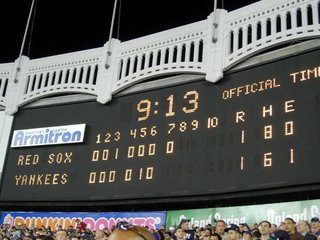
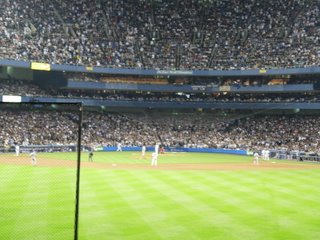 Rallying with two outs, Jason Giambi draws a bases loaded walk to bring in Miguel Cairo with the second run, and Wang now has a chance to earn the win.
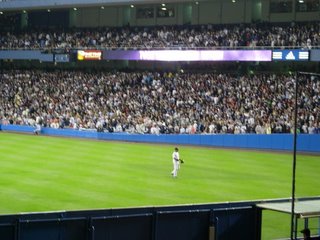
Melky Cabrera receives cheers after returning to left field in the top of the ninth. Cabrera made an amazing game-saving catch in left-center to rob Boston's Manny Ramirez of a game-tying home run.
 Wang gets Coco Crisp to ground to Andy Phillips who throws to Wang for the out at first base to end the top of the seventh inning.
Wang completes seven innings, but the game is tied. Can he get some support in the bottom of the inning?
 Rallying with two outs, Jason Giambi draws a bases loaded walk to bring in Miguel Cairo with the second run, and Wang now has a chance to earn the win.
Melky Cabrera receives cheers after returning to left field in the top of the ninth. Cabrera made an amazing game-saving catch in left-center to rob Boston's Manny Ramirez of a game-tying home run.
Saturday, May 27, 2006
Wang defeats Royals for fifth win
 The winning pitcher.
 Catcher Kelly Stinnett had a surprisingly good game.
 Wang warming up before the first inning.
 Stinnett arrives at the plate after a three-run shot to left.
Wednesday, May 17, 2006
Wang beats the Rangers for his fourth win of the season
Wang wins!!!
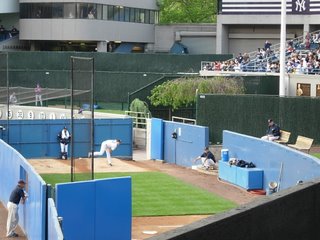 Wang warms up.
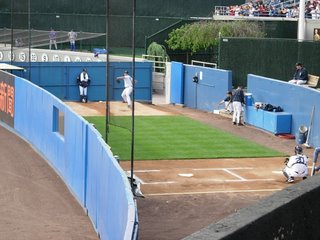 Jorge Posada catches Wang's pitches. Posada had a walk-off home run the previous night and would have more clutch hitting to help Wang beat the Rangers.
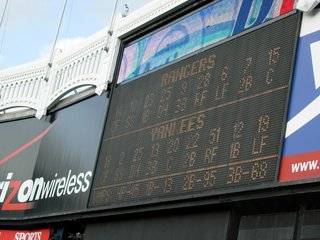 Starting lineups.
 Wang warms up.
 Jorge Posada catches Wang's pitches. Posada had a walk-off home run the previous night and would have more clutch hitting to help Wang beat the Rangers.
 Starting lineups.
Sunday, August 07, 2005
The Irascible Prophet: V. S. Naipaul at Home
The Irascible Prophet: V. S. Naipaul at Home
Two monuments rise like emblems from the green countryside of Wiltshire, England, not far from the secluded house of V. S. Naipaul: Stonehenge and Salisbury Cathedral. They are signposts in a landscape Naipaul has been traversing for more than half a century, one in which the impulses of culture, civilization and progress have always existed in close and uneasy proximity to the impulses of paganism, religion and disorder.
A prophet of our world-historical moment, in his more than 25 works of fiction and nonfiction, Naipaul has examined the clash between belief and unbelief, the unraveling of the British Empire, the migrations of peoples. They are natural subjects for a writer who, as he has recorded in his many fully, semi- and quasi-autobiographical books, was born in Trinidad, where his grandfather had emigrated from India as an indentured servant. His father, a newspaper reporter and aspiring fiction writer, was the model for what is arguably Naipaul's finest novel, "A House for Mr. Biswas" (1961). At 18, Naipaul left Trinidad on a scholarship to University College, Oxford, and has lived in England ever since. Alfred Kazin once described him as "a colonial brought up in English schools, on English ways and the pretended reasonableness of the English mind."
Knighted in 1990, Sir Vidiadhar Surajprasad Naipaul is Britain's only living Nobel laureate in literature, having been awarded the prize in October 2001, a season when many were just awakening to realities Naipaul had been writing about for more than 20 years. Also significant is that he had explored Islamic fundamentalism and other issues of global import not through fiction, but through nonfiction reportage. The novel's time was over, he had said. Others had made the claim before, but it resonated more deeply coming from a contemporary giant. What is more, Naipaul said, only nonfiction could capture the complexities of today's world. It was a profound observation. But did it speak to a larger cultural situation, or was it simply the personal judgment of one cantankerous writer, who in fact continued to publish a novel every few years even after declaring the form dead?
Naipaul recently offered some thoughts on the matter, in an interview in the cozy sitting room of his cottage in Wiltshire. Photograph portraits were on the mantle. French novels lined one bookshelf. The sounds of the outside world could be heard: a lawnmower, the buzzing of a fighter jet from a nearby airbase. A compact man of 72, Naipaul has been ill in recent months, and said he is not working on a book at the moment. Although it was unseasonably hot on the splendid sunny afternoon of the longest day of the year, he wore a tweed jacket and corduroy pants. Unsmiling, he settled somewhat stiffly onto a straight-backed armchair and began to chart the trajectory of his thinking.
"What I felt was, if you spend your life just writing fiction, you are going to falsify your material," he said. "And the fictional form was going to force you to do things with the material, to dramatize it in a certain way. I thought nonfiction gave one a chance to explore the world, the other world, the world that one didn't know fully." Naipaul's voice is rich and deep and mellowed by tobacco, and when he pronounced the word "world," he savored it, drawing it out to almost three syllables. "I thought if I didn't have this resource of nonfiction I would have dried up perhaps. I'd have come to the end of my material, and would have done what a writer like Graham Greene did. You know, he took the Graham Greene figure to the Congo, took him to Argentina, took him to Haiti, for no rhyme or reason."
Naipaul has said he wrote the novel "Half a Life" (2001) only to fulfill a publisher's contract, and that "Magic Seeds" (2004) would be his last novel. (Over the years, he has often hinted at retirement, only to publish another book soon after.) Yet the fact that Naipaul has continued to write novels does not undercut his acute awareness of the form's limitations; indeed, it amplifies it. His is the lament of a writer who, through a life devoted to his craft, has discovered that the tools at his disposal are no longer adequate. "If you write a novel alone you sit and you weave a little narrative. And it's O.K., but it's of no account," Naipaul said. "If you're a romantic writer, you write novels about men and women falling in love, etc., give a little narrative here and there. But again, it's of no account."
What is of account, in Naipaul's view, is the larger global political situation -- in particular, the clash between belief and unbelief in postcolonial societies. "I became very interested in the Islamic question, and thought I would try to understand it from the roots, ask very simple questions and somehow make a narrative of that discovery," he said. To what extent, he wondered, had "people who lock themselves away in belief . . . shut themselves away from the active busy world"? "To what extent without knowing it" were they "parasitic on that world"? And why did they have "no thinkers to point out to them where their thoughts and their passion had led them"? Far from simple, the questions brought a laserlike focus to a central paradox of today's situation: that some who have benefited from the blessings of the West now seek to destroy it.
In November 2001 Naipaul told an audience of anxious New Yorkers still reeling from the attack on the World Trade Center that they were facing "a war declared on you by people who passionately want one thing: a green card." What happened on Sept. 11 "was too astonishing. It's one of its kind. It can't happen again," he said in our conversation. "But in the end it has had no effect on the world. It has just been a spectacle, like a bank raid in a western film. They will be caught by the sheriff eventually." The bigger issue, he said, is that Western Europe, while built on tolerance, today lacks "a strong cultural life," making it vulnerable to Islamicization. He even went so far as to say that Muslim women shouldn't wear headscarves in the West. "If you decide to move to another country and to live within its laws you don't express your disregard for the essence of the culture," he said. "It's a form of aggression."
No matter how uncomfortable or debatable, there is a painful prescience to Naipaul's observations on Islam and the West. That prescience was in evidence once again when, just two weeks after our meeting, bombers struck the London Underground and a city bus, killing more than 50 people. Naipaul was at home in Wiltshire that day, and professed no surprise that the attacks appeared to have been carried out by British citizens. "We must stop fooling ourselves about what we are witnessing," he said in a telephone conversation a week after the July 7 attacks. The debate in Britain about British detainees held at Guantánamo Bay was evidence of the foolishness. "People here talk about those people who were picked up by the Americans as 'lads,' 'our lads,' as though they were people playing cricket or marbles," Naipaul said. "It's glib, nonsensical talk from people who don't understand that holy war for Muslims is a religious war, and a religious war is something you never stop fighting."
These remarks, like so many of Naipaul's utterances over the years, seem calculated to provoke. In his interviews as in his life, Naipaul is famously irascible, difficult, contradictory, an ideological lightning rod. Yet in his writing, he is an artist on whom nothing is lost. Naipaul addressed this split in his Nobel acceptance speech, in which he seconded Proust's argument that "a book is the product of a different self from the self we manifest in our habits, in our social life, in our vices." Naipaul's work is as subtle as his interviews are clamorous. In "Among the Believers: An Islamic Journey," his 1981 travelogue through the ironies and intricacies of non-Arab Islamic countries, and in its 1998 follow-up, "Beyond Belief," Naipaul listened seriously and empathetically to people in Iran, Pakistan, Indonesia and Malaysia: countries that were converted to Islam over the course of centuries and, in the late 70's, witnessed a rise in both power and Islamic fundamentalism. The books raise but don't necessarily answer deep and vexing questions: Is secularism a precondition of tolerance? Does one necessarily have to abandon one's individual cultural and religious identity to become part of the West? Why do people willingly choose lives that restrict their intellectual freedom? What becomes of modern societies founded on Islam, whose strictest aherents long for a return to the time of Muhammad?
Like Salim, the protagonist of his classic novel "A Bend in the River," who describes himself as "a man without a side," Naipaul has cultivated political detachment. In his Nobel acceptance speech, he said: "I have always moved by intuition alone. I have no system, literary or political. I have no guiding political idea." This is both true and incomplete. Naipaul's cold, unsparing look at the corruption and disarray of the postcolonial world, his disdain for Marxist liberation movements and his view that Islamic society leads to tyranny are implicitly political positions, and have made him the object of much political criticism. He has been sharply criticized by, among others, Derek Walcott, the Caribbean poet and Nobel laureate, and Chinua Achebe, the Nigerian novelist, who said "although Naipaul was writing about Africa, he was not writing for Africans." The scholar and critic Edward Said, who died in 2003, called "Beyond Belief" "an intellectual catastrophe." Naipaul, he added, thinks "Islam is the worst disaster that ever happened to India, and the book reveals a pathology."
But what spares Naipaul's work from the ideology of critics who would dismiss him as anti-Muslim and admirers who would laud him for essentially the same thing is its unsentimental, often heartbreaking detail. In "Among the Believers," Naipaul speaks with Mr. Jaffrey, a newspaper journalist and British-Indian-educated Shiite in Tehran who supported Khomeini as a way of bringing about the Islamic dream of a "society of believers." Mr. Jaffrey ate a plate of fried eggs as he spoke. In "Beyond Belief," Naipaul revisits one of the journalist's colleagues, who also relishes his lunch. Ideology is abstract; fried eggs are not. Naipaul's nonfiction has the force, the almost unbearable density of detail and the moral vision of great fiction. It comes as no surprise that Dickens and Tolstoy are his heroes. For all Naipaul's talk about the limitations of the novel, the power of his work is ultimately rooted in a novelist's preternatural attentiveness to individual human lives and triumphs, to the daily things we do that make us who we are, and are the key to our survival.
A breakthrough in Naipaul's own understanding of himself as a writer and his turning away from the novel toward nonfiction came in a remarkable essay he wrote on Joseph Conrad. First published in The New York Review of Books in 1974, it appears in his 2003 collection, "Literary Occasions." It is not entirely surprising that Naipaul would turn to the work of the Polish émigré; both were raised in one world and willed themselves into becoming artists in another, England. "I suppose that in my fantasy I had seen myself coming to England as to some purely literary region, where, untrammeled by the accidents of history or background, I could make a romantic career for myself as a writer," Naipaul wrote in that essay.
"It came to me that the great novelists wrote about highly organized societies," he wrote. "I had no such society; I couldn't share the assumptions of the writers; I didn't see my world reflected in theirs. My colonial world was more mixed and secondhand, and more restricted. The time came when I began to ponder the mystery -- Conradian word -+of my own background." Along the way, Naipaul kept coming up against Conrad. "I found that Conrad -- 60 years before, in the time of a great peace -+had been everywhere before me," he wrote. "Not as a man with a cause, but a man offering . . . a vision of the world's half-made societies as places which continuously made and unmade themselves, where there was no goal, and where always 'something inherent in the necessities of successful action . . . carried with it the moral degradation of the idea.' Dismal, but deeply felt: a kind of truth and half a consolation."
Yet in our conversation, although Naipaul said he thought Conrad was "great" because he "wished to look very, very hard at the world," he also insisted that Conrad "had no influence on me." "Actually, I think 'A Bend in the River' is much, much better than Conrad," he said. "I think the best part of Conrad's 'Heart of Darkness' is the reportage part. The fictional part is excessive and feeble. And there is no reportage in my thing. I was looking and creating that world. I actually think the work I've done in that way is better than Conrad." Naipaul also dismissed the idea there might be a direct link between his Conrad essay and subsequent works in which he explored some of the same places and themes. "These things might appear like that. But that's only for a person on the outside," he said.
A different picture emerges from Naipaul's bibliography. After the Conrad essay, Naipaul in fact followed Conrad's itinerary to the Congo -- the subject of his nonfiction essay on Mobutu, "A New King for the Congo"(1975), and of "A Bend in the River" (1979); and to Aceh, Indonesia, for "Among the Believers" and "Beyond Belief." Naipaul has also gone where Conrad went as a narrator, cultivating a kind of finely wrought ambiguity and moving toward reportage. "To understand Conrad," as he wrote in his essay, "it was necessary to begin to match his experience. It was also necessary to lose one's preconceptions of what the novel should do and, above all, to rid oneself of the subtle corruptions of the novel or comedy of manners."
In conversation, another dynamic becomes apparent, in which the more dismissive Naipaul is of a writer, the more likely it is that he has engaged deeply with that writer's work. Sitting a few feet away from a bookshelf of French novels, Naipaul called Proust "tedious," "repetitive," "self-indulgent," concerned only with a character's social status. "What is missing in Proust is this idea of a moral center," he said. Naipaul also had little respect for Joyce's "Ulysses" -- "the Irish book," he sniffily called it -- and other works "that have to lean on borrowed stories." Lately, he has found Stendhal "repetitive, tedious, infuriating," while "the greatest disappointment was Flaubert."
All this points to another idea: Modernism is over. "We are all overwhelmed by the idea of French 19th-century culture. Everybody wanted to go to Paris to paint or to write. And of course that's a dead idea these days," Naipaul said. "We've changed. The world has changed. The world has grown bigger." Which brings us back to the limitations of the novel. The writer must leave the sitting room and travel abroad into the active, busy world. It is the tragic vision only a novelist can reach: that the world cannot be contained in the novel.
And yet, for all his laments, Naipaul is not invested in the notion that Western civilization is in decline. "That's a romantic idea," he said brusquely. "A civilization which has taken over the world cannot be said to be dying. . . . It's a university idea. People cook it up at universities and do a lot of lectures about it. It has no substance." The "philosophical diffidence" of the West, he maintains, will prevail over the "philosophical shriek" of those who intend to destroy it. Naipaul formulated those terms in a lecture he delivered in 1992 at the Manhattan Institute, a conservative think tank in New York. (Called "Our Universal Civilization," it appears in his 2002 essay collection, "The Writer and the World.") In it, he cites a remarkable passage from Conrad: "A half-naked, betel-chewing pessimist stood upon the bank of the tropical river, on the edge of the still and immense forests; a man angry, powerless, empty-handed, with a cry of bitter discontent ready on his lips; a cry that, had it come out, would have rung through the virgin solitudes of the woods as true, as great, as profound, as any philosophical shriek that ever came from the depths of an easy chair to disturb the impure wilderness of chimneys and roofs."
As for evidence of the diffidence: "I think it actually is all around us. It's all around us," Naipaul said. But where, exactly? "There are millions and millions of people all around us," was all he would say. In "India: A Million Mutinies Now" (1990), his third nonfiction book about India, Naipaul celebrated the million manifestations of daily life, of lives undefeated by the chaos, disarray and poverty of the larger society. A Hindu by birth, though not observant, Naipaul finds India a place of great hope. It is, he says, the country where belief and unbelief coexist most peaceably. The economic development of India -- and China -- he said, will "completely alter the world," and "nothing that's happening in the Arab world has that capacity." Yet Naipaul called it "a calamity" that, even with its billion people, "there are no thinkers in India" today. India is also where he turns for a theory of history. "The only theory is that everything is in a state of flux," he said. This is his own "personal idea," he said, but one linked to a philosophical concept in Indian religion.
"I find it impossible to contain the history of Europe in my head. It's so much movement, so much movement," he said. "Even when you go back to the Roman times there are these tribal groups pressing all the time, pressing and pressing and pressing," he continued, pushing his fists together for emphasis and fixing his gaze intently at the near distance. He has recently been reading the letters of Mary Wortley Montagu, an Englishwoman who traveled across the Ottoman Empire in the 18th century. The chaos of history pressed in on the Wiltshire sitting room. "You have this picture of the devastation the Turks had created in Hungary," he said. "Who ever thought that world would have changed if you were living at that time? But it has changed. And what we're living in will of course change again."
Dismal, but deeply felt: a kind of truth and half a consolation.
Rachel Donadio is a writer and editor at the Book Review.
Saturday, May 07, 2005
The Gravest Generation
The Gravest Generation
LÜBECK, Germany - Tomorrow, it will be 60 years to the day since the German Reich's unconditional surrender. That is equivalent to a working life with a pension to look forward to. It goes so far back that memory, that wide-meshed sieve, is in danger of forgetting it.
Sixty years ago, after being wounded in the chaotic retreat in Lausitz, I lay in a hospital with a flesh wound in my right thigh and a bean-sized shell splinter in my right shoulder. The hospital was in Marienbad, a military hospital town that had been occupied by American soldiers a few days earlier, at the same time as Soviet forces were occupying the neighboring town of Karlsbad. In Marienbad, on May 8, I was a naïve 17-year-old who had believed in the ultimate victory right to the end. Those who had survived the mass murder in the German concentration camps could regard themselves as liberated, although they were in no physical condition to enjoy their freedom. But for me it was not the hour of liberation; rather, I was beset by the empty feeling of humiliation following total defeat.
When May 8 comes round again and is celebrated in complacent official speeches as liberation day, this can only be in hindsight, especially as we Germans did little if anything for our liberation. In the initial postwar years our lives were determined by hunger and cold, the misery of refugees, the displaced and bombed-out. In all four zones occupied by the wartime allies -- Britain, France, the Soviet Union and the United States -- the only way to manage the ever increasing crush of the more than 12 million Germans who had fled from, or been driven out of, East and West Prussia, Pomerania, Silesia and the Sudetenland, was to force them into our own cramped living rooms.
Whenever the question is posed, "What can we Germans be proud of?", the first thing we should mention is this essential achievement -- even though it was forced on us. We had hardly become used to freedom when compulsion had to be applied. As a result, in both German states, huge long-term camps for refugees and displaced persons were avoided. The risk of building up feelings of hate was thereby diverted, as was the desire for revenge engendered by years of camp life, which, as today's world shows, can result in terrorism and counterterrorism.
Even then there were spokesmen for the rhetoric of liberation. So many self-appointed anti-fascists suddenly set the tone, so much so that one was entitled to ask: how had Hitler been able to make headway against such strong resistance? Dirty linen was quickly washed clean, with people being absolved of all responsibility. Counterfeiters were busy coining new expressions and putting them into circulation. "Unconditional surrender" was changed to "collapse." Although in business, law and in the rapidly re-emerging schools and universities, even the diplomatic service, many former National Socialists maintained their hereditary wealth, stayed in office, continued to hold onto their university chairs and eventually continued their careers in politics, it was claimed that we were starting from "zero hour" or square one.
A particularly infamous distortion of facts can be seen even today in speeches and publications, with the crimes perpetrated by Germans described as "misdeeds perpetrated in the name of the German people." In addition, language was used in two different ways to herald the future division of the country. In the Soviet-occupied zone, the Red Army had liberated Germany from the fascist terror all by itself; in the Western occupied zones, the honor of having freed not only Germany but the whole of Europe from Nazi domination was shared exclusively by the Americans, the British and the French.
In the cold war that quickly followed, German states that had existed since 1949 consistently fell to one or other power bloc, whereupon the governments of both national entities sought to present themselves as model pupils of their respective dominating powers. Forty years later, during the glasnost period, it was in fact the Soviet Union that broke up the Democratic Republic, which had by that point become a burden. The Federal Republic's almost unconditional subservience to the United States was broken for the first time when the Social Democratic-Green ruling coalition decided to make use of the freedom given to us in sovereign terms 60 years ago, by refusing to allow German soldiers to participate in the Iraq war.
THE question today, then, is have we dealt carefully with the freedom that we did not win, but was given to us? Have the citizens of West Germany properly compensated the citizens of the former Democratic Republic, who, after all, had to bear the main burden of the war begun and lost by all Germans? And a further question: is our parliamentary democracy still sufficiently sovereign as a guarantor of freedom of action to act on the problems facing us in the 21st century?
Fifteen years after signing the treaty on unification, we can no longer conceal that despite the financial achievements, German unity has essentially been a failure. Petty calculation prevented the government of the time from submitting to the citizens of both states a new constitution relevant to the endeavors of Germany as a whole. It is therefore hardly surprising that people in the former East Germany should regard themselves as second-class Germans.
The jobless rate is twice as high as in the former West Germany. West German arrogance had no respect for people with East German résumés. The mass migration, feared from the beginning, is happening now, daily. Whole areas of the country, its cities and its villages, are being emptied. After the Treuhandanstalt, the entity responsible for privatizing East Germany, had completed its bargain sales, West German industry and banks withheld the necessary investment and loans and, consequently, no jobs were created. Here, fine exhortations have been of little use. To right this skewed situation, only Parliament, the lawmakers, can help. Which brings us back to the question of whether parliamentary democracy is able to act.
Now, I believe that our freely elected members of Parliament are no longer free to decide. The customary party pressures are not particularly present in Germany; it is, rather, the ring of lobbyists with their multifarious interests that constricts and influences the Federal Parliament and its democratically elected members, placing them under pressure and forcing them into disharmony, even when framing and deciding the content of laws. Consequently, Parliament is no longer sovereign in its decisions. It is steered by the banks and multinational corporations -- which are not subject to any democratic control.
What's needed is a democratic desire to protect Parliament against the pressures of the lobbyists by making it inviolable. But are our parliamentarians still sufficiently free to make a decision that would bring radical democratic constraint? Or is our freedom now no more than a stock market profit?
We all are witnesses to the fact that production is being demolished worldwide, that so-called hostile and friendly takeovers are destroying thousands of jobs, that the mere announcement of measures like the dismissal of workers and employees makes share prices rise, and this is regarded unthinkingly as the price to be paid for "living in freedom."
The consequences of this development disguised as globalization are clearly coming to light and can be read from the statistics. With the consistently high number of jobless, which in Germany has now reached five million, and the equally constant refusal of industry to create jobs, despite demonstrably higher earnings, especially from exports, the hope of full employment has evaporated.
Older employees, who still had years of work left in them, are pushed into early retirement. Young people are denied the skills for entering the world of work. Even worse, with complaints that an aging population is a threat and simultaneous demands, repeated parrot-fashion, to do more for young people and education, the Federal Republic -- still a rich country -- is permitting, to a shameful extent, the growth of what is called "child poverty."
All this is now accepted as if divinely ordained, accompanied at most by the customary national grumbles. Worse, those who point to this state of affairs and to the people forced into social oblivion are at best ridiculed by slick young journalists as "social romantics," but usually vilified as "do-gooders." Questions about the reasons for the growing gap between rich and poor are dismissed as "the politics of envy." The desire for justice is ridiculed as utopian. The concept of "solidarity" is relegated to the dictionary's list of foreign words.
THOUGH we initially did not know what to do with our freedom when we were given it 60 years ago, we gradually made use of this gift. We learned democracy and in doing so proved star pupils, because after all we were incontrovertibly German. With the benefit of hindsight, what was crammed into us through lectures was enough to get us a reasonable end-of-term report. We learned the interplay between government and opposition, whereupon long periods of government ultimately proved arid. The much lauded and reviled generation of '68 produced a different kind of political leaders and ultimately also tolerance. We had to acknowledge that our burdens could not be cast aside, they are passed by parents to children and that our German past, however much we travel and export, comes back to haunt us. Neo-Nazis repeatedly brought us into disrepute. Even so, we felt that democracy was here to stay.
It had to withstand several challenges. After the debris had been cleared and disposed of in both German states, reconstruction in the East proceeded under the constraints of the Stalinist system; but in the West, it took place under favorable conditions. What retrospectively is called the "economic miracle" was not, however, the result of any individual achievement but was won by many. Included in that number are displaced persons and refugees, those who had in fact to start at square one in terms of material possessions. We must not forget the contribution of foreign workers, initially politely called "guest workers." In the rebuilding phase businessmen were exemplary in investing every penny of profit into job creation. The trade unions and businesses were clearly aware of the decay of the Weimar Republic, so they were forced to compromise and ensure social equality.
With so much toil and profit-chasing, however, the past was in danger of being forgotten. Only in the 60's did we meet the second challenge, when writers and then the student protest movement began to ask questions about everything that the war generation would sooner forget. The protest movement strove for revolution but was paid off with reform; without it, we would still be living in the claustrophobic fog of the postwar years under Adenauer.
The third challenge arose when the Berlin Wall fell. The two German states had existed for four decades more against than beside each other. As there was no willingness on the Western side to offer equal rights to the East, the unity of the country has so far existed only on paper. It was all done too hastily and without an understanding of what far-reaching consequences this haste would have.
Since then, the expanded country has stagnated. Neither the Kohl government nor the Schröder government succeeded in correcting the initial errors. Lately, perhaps too late, we have come to recognize that the threat to the state, or what should be regarded as Public Enemy No. 1, comes not from right-wing radicalism but rather, from the impotence of politics, which leaves citizens exposed and unprotected from the dictates of the economy. What is being destroyed, then, is not the state, which survives, but democracy.
When the German Reich unconditionally surrendered 60 years ago, a system of power and terror was thereby defeated. This system, which had caused fear throughout Europe for 12 years, still casts its shadow today. We Germans have repeatedly faced up to this inherited shame and have been forced to do so if we hesitated. The memory of the suffering that we caused others and ourselves has been kept alive through the generations. Compared with other nations which have to live with shame acquired elsewhere -- I'm thinking of Japan, Turkey, the former European colonial powers -- we have not shaken off the burden of our past. It will remain part of our history as a challenge.
We can only hope we will be able to cope with today's risk of a new totalitarianism, backed as it is by the world's last remaining ideology. As conscious democrats, we should freely resist the power of capital, which sees mankind as nothing more than something which consumes and produces. Those who treat their donated freedom as a stock market profit have failed to understand what May 8 teaches us every year.
Op-Ed Contributor Günter Grass, the author of "The Tin Drum" and, most recently, "Crabwalk," won the Nobel Prize in Literature in 1999. This article was translated from the German by UPS Translations.
Tuesday, March 29, 2005
From Budapest to Los Alamos, a Life in Mathematics
From Budapest to Los Alamos, a Life in Mathematics
In the world of modern mathematics, Dr. Peter D. Lax, professor emeritus at New York University, ranks among the giants.
As a teenage refugee from the Nazis, he worked on the Manhattan Project at Los Alamos, where met the likes of Hans Bethe, Richard Feynman and Edward Teller.
As a young mathematician, he was a protégé of John von Neumann, a father of modern computing.
Dr. Lax's own work, at N.Y.U.'s Courant Institute of Mathematical Sciences, has often straddled the territory where theoretical mathematics and applied physics meet.
He is widely known for his work on wave theory, and his discoveries there are used for weather prediction, airplane design and telecommunications signaling.
This month, the Norwegian Academy of Science and Letters announced that Dr. Lax, who is 78, would receive its third Abel Prize, accompanied by $980,000, an honor created to compensate for the absence of a mathematics category among the Nobel Prizes.
"I don't know what I'll be doing with all that money," he said in an interview last week at his apartment in Manhattan. "I won't give it all away. I'm not rich. Some of it I will give to good causes, mainly in science."
Thanks for reading The Times.
Subscribe to The Times
Q. When did you come to the United States?
A. My parents, my brother and I left Budapest in late November of 1941. I was 15 1/2. We were able to get out -- we are Jewish -- because my father was a physician. The American consul in Budapest was his friend and patient.
And so we went by train across Europe, through Germany in train compartments filled with Wehrmacht troops. We sailed for America from Lisbon on Dec. 5, 1941.
While we were on the high seas, the war broke out. So we left as immigrants and arrived in New York as enemy aliens. Within a month, my brother and I were in high school. I went to Stuyvesant.
Editors’ Picks
This Time-Management Trick Changed My Whole Relationship With Time
How a Writer With a Ph.D. in Psychology Became a Poker Champ
Lessons on Coronavirus Testing From the Adult Film Industry
Q. In Hungary, you were a math prodigy. How did the New York public schools measure up?
A. I didn't take any math courses at Stuyvesant. I knew more than most of the teachers. But I had to take English and American history, and I quickly fell in love with America. In history, we had a text, and the illustrations were contemporary cartoons. I thought that was marvelous. I couldn't imagine a Hungarian textbook taking such a less-than-worshipful attitude.
Q. When were you drafted, and how did the Army affect your career?
A. In 1944. I was 18 and I spent six very pleasant months at Texas A&M, at an Army training program in engineering there. Later, I was sent to Los Alamos, and that was like science fiction. There were all these legends everywhere.
I arrived about six weeks before the A-bomb test. There was not too much secrecy inside the fence. That was Oppenheimer's policy. People told me, "We're building an atomic bomb, partly radium, but maybe plutonium, which doesn't exist in the universe, but we are manufacturing it at Hanford."
Q. Were the personality and policy clashes between Teller and J. Robert Oppenheimer evident even then?
A. I was the low man on the totem pole. But I understood what was going on. Looking back, there were two issues: should we have dropped the A-bomb and should we have built a hydrogen bomb?
Today the revisionist historians say that Japan was already beaten, and so the bomb wasn't necessary. I disagree. I remember being in the Army when the Germans surrendered, and we all assumed we were going to be sent to the Pacific next. I also think that Teller was right about the hydrogen bomb because the Russians were sure to develop it. And if they had been in possession of it, and the West not, they would have gone into Western Europe. What would have held them back?
Teller was certainly wrong in the 1980's about Star Wars. And that is still with us today. And it's draining a lot of money we don't have.
What I think was not right of Teller was to bring Star Wars to the White House though the back door, without going through the scientific community.
The system doesn't work. It's a phantasmagoria. But once you had Reagan charmed by it and Bush charmed by it, it became very hard to put an end of something that the president wants.
Q. What do you think your mentor John von Neumann would think about the ubiquity of computers today?
A. I think he'd be surprised. But nobody could have predicted that everybody and their cousin would have personal computers -- although I think of all people, he would have figured it out. Nobody can predict things, but you can see where something's heading.
He could see very far, very far. He saw the use of computers very broadly. But remember, he died in 1957 and did not live to see transistors replace vacuum tubes. Once you had transistors, you could miniaturize computers.
Q. Did you know John Nash, the protagonist of the film "A Beautiful Mind"?
A. I did, and I had enormous respect for him. He solved three very difficult mathematical problems and then he turned to the Riemann hypothesis, which is deep mystery. By comparison, Fermat's is nothing. With Fermat's -- once they found a connection to another problem -- they could do it. But the Riemann hypothesis, there are many connections, and still it cannot be done. Nash tried to tackle it and that's when he broke down.
Q. Do you believe that high school and college math are poorly taught?
A. By and large, that's correct. I would like to see the schools of education teach much more math than methods of teaching and educational psychology. In mathematics, nothing takes the place of real knowledge of the subject and enthusiasm for it.
Q. What do you consider your most significant contributions?
A. There are about five or six things that had an impact. Among them is my work on shock waves, where I clarified shock wave theory and combined it with practical numerical methods for calculating flows with shock waves.
At Los Alamos, this was important to understand how weapons work, but it is equally important in understanding how airplanes at high speed fly through the air.
Ralph Phillips and I came up with the Lax-Phillips semigroup in scattering theory that was a new idea and could be used in quite surprising number of directions. This helped understand radar pictures.
Recently Martin Kruskal and his collaborators have unexpectedly discovered brand new completely integrable systems, and I have helped clarify some things about such systems.
I was able to analyze, with my student Dave Levermore, what happens to solutions of dispersive systems when dispersion tends to zero.
It is a rather surprising new phenomenon, but not easy to express in layman's terms. In a report to the American Philosophical Society I put it into the form of haiku:
Speed depends on size
Balanced by dispersion
Oh, solitary splendor.
Q. Has mathematics become too complex for anyone to understand all of it?
A. Compared to physics or chemistry, mathematics is a very broad subject. It is true that nobody can know it all, or even nearly all. But it is also true that as mathematics develops, things are simplified and unusual connections appear.
Geometry and algebra for instance, which were so very different 100 years ago, are intricately connected today.
A Conversation With Peter Lax Correction: April 11, 2005, Monday A question-and-answer interview in Science Times on March 29 with the mathematician Peter D. Lax, who took part in the Manhattan Project as a young man, misstated a word in his comment recalling the first atomic bomb. The components included uranium, not radium.
In the world of modern mathematics, Dr. Peter D. Lax, professor emeritus at New York University, ranks among the giants.
As a teenage refugee from the Nazis, he worked on the Manhattan Project at Los Alamos, where met the likes of Hans Bethe, Richard Feynman and Edward Teller.
As a young mathematician, he was a protégé of John von Neumann, a father of modern computing.
Dr. Lax's own work, at N.Y.U.'s Courant Institute of Mathematical Sciences, has often straddled the territory where theoretical mathematics and applied physics meet.
He is widely known for his work on wave theory, and his discoveries there are used for weather prediction, airplane design and telecommunications signaling.
This month, the Norwegian Academy of Science and Letters announced that Dr. Lax, who is 78, would receive its third Abel Prize, accompanied by $980,000, an honor created to compensate for the absence of a mathematics category among the Nobel Prizes.
"I don't know what I'll be doing with all that money," he said in an interview last week at his apartment in Manhattan. "I won't give it all away. I'm not rich. Some of it I will give to good causes, mainly in science."
Thanks for reading The Times.
Subscribe to The Times
Q. When did you come to the United States?
A. My parents, my brother and I left Budapest in late November of 1941. I was 15 1/2. We were able to get out -- we are Jewish -- because my father was a physician. The American consul in Budapest was his friend and patient.
And so we went by train across Europe, through Germany in train compartments filled with Wehrmacht troops. We sailed for America from Lisbon on Dec. 5, 1941.
While we were on the high seas, the war broke out. So we left as immigrants and arrived in New York as enemy aliens. Within a month, my brother and I were in high school. I went to Stuyvesant.
Editors’ Picks
This Time-Management Trick Changed My Whole Relationship With Time
How a Writer With a Ph.D. in Psychology Became a Poker Champ
Lessons on Coronavirus Testing From the Adult Film Industry
Q. In Hungary, you were a math prodigy. How did the New York public schools measure up?
A. I didn't take any math courses at Stuyvesant. I knew more than most of the teachers. But I had to take English and American history, and I quickly fell in love with America. In history, we had a text, and the illustrations were contemporary cartoons. I thought that was marvelous. I couldn't imagine a Hungarian textbook taking such a less-than-worshipful attitude.
Q. When were you drafted, and how did the Army affect your career?
A. In 1944. I was 18 and I spent six very pleasant months at Texas A&M, at an Army training program in engineering there. Later, I was sent to Los Alamos, and that was like science fiction. There were all these legends everywhere.
I arrived about six weeks before the A-bomb test. There was not too much secrecy inside the fence. That was Oppenheimer's policy. People told me, "We're building an atomic bomb, partly radium, but maybe plutonium, which doesn't exist in the universe, but we are manufacturing it at Hanford."
Q. Were the personality and policy clashes between Teller and J. Robert Oppenheimer evident even then?
A. I was the low man on the totem pole. But I understood what was going on. Looking back, there were two issues: should we have dropped the A-bomb and should we have built a hydrogen bomb?
Today the revisionist historians say that Japan was already beaten, and so the bomb wasn't necessary. I disagree. I remember being in the Army when the Germans surrendered, and we all assumed we were going to be sent to the Pacific next. I also think that Teller was right about the hydrogen bomb because the Russians were sure to develop it. And if they had been in possession of it, and the West not, they would have gone into Western Europe. What would have held them back?
Teller was certainly wrong in the 1980's about Star Wars. And that is still with us today. And it's draining a lot of money we don't have.
What I think was not right of Teller was to bring Star Wars to the White House though the back door, without going through the scientific community.
The system doesn't work. It's a phantasmagoria. But once you had Reagan charmed by it and Bush charmed by it, it became very hard to put an end of something that the president wants.
Q. What do you think your mentor John von Neumann would think about the ubiquity of computers today?
A. I think he'd be surprised. But nobody could have predicted that everybody and their cousin would have personal computers -- although I think of all people, he would have figured it out. Nobody can predict things, but you can see where something's heading.
He could see very far, very far. He saw the use of computers very broadly. But remember, he died in 1957 and did not live to see transistors replace vacuum tubes. Once you had transistors, you could miniaturize computers.
Q. Did you know John Nash, the protagonist of the film "A Beautiful Mind"?
A. I did, and I had enormous respect for him. He solved three very difficult mathematical problems and then he turned to the Riemann hypothesis, which is deep mystery. By comparison, Fermat's is nothing. With Fermat's -- once they found a connection to another problem -- they could do it. But the Riemann hypothesis, there are many connections, and still it cannot be done. Nash tried to tackle it and that's when he broke down.
Q. Do you believe that high school and college math are poorly taught?
A. By and large, that's correct. I would like to see the schools of education teach much more math than methods of teaching and educational psychology. In mathematics, nothing takes the place of real knowledge of the subject and enthusiasm for it.
Q. What do you consider your most significant contributions?
A. There are about five or six things that had an impact. Among them is my work on shock waves, where I clarified shock wave theory and combined it with practical numerical methods for calculating flows with shock waves.
At Los Alamos, this was important to understand how weapons work, but it is equally important in understanding how airplanes at high speed fly through the air.
Ralph Phillips and I came up with the Lax-Phillips semigroup in scattering theory that was a new idea and could be used in quite surprising number of directions. This helped understand radar pictures.
Recently Martin Kruskal and his collaborators have unexpectedly discovered brand new completely integrable systems, and I have helped clarify some things about such systems.
I was able to analyze, with my student Dave Levermore, what happens to solutions of dispersive systems when dispersion tends to zero.
It is a rather surprising new phenomenon, but not easy to express in layman's terms. In a report to the American Philosophical Society I put it into the form of haiku:
Speed depends on size
Balanced by dispersion
Oh, solitary splendor.
Q. Has mathematics become too complex for anyone to understand all of it?
A. Compared to physics or chemistry, mathematics is a very broad subject. It is true that nobody can know it all, or even nearly all. But it is also true that as mathematics develops, things are simplified and unusual connections appear.
Geometry and algebra for instance, which were so very different 100 years ago, are intricately connected today.
A Conversation With Peter Lax Correction: April 11, 2005, Monday A question-and-answer interview in Science Times on March 29 with the mathematician Peter D. Lax, who took part in the Manhattan Project as a young man, misstated a word in his comment recalling the first atomic bomb. The components included uranium, not radium.